The Journal
THE LEAD
-
Han Youngsoo: A Modern Eye in Postwar Korea
Discovering Han Youngsoo at Frieze, I was struck first by the style of postwar Seoul, then by the photographer’s eye: precise, playful, and still compelling today.

FEATURED STORIES
-
Whose Seoul are you following?
We usually decide where to go by looking at places already getting attention. Your Seoul, Today began with two other starting points: what I am looking for, and what the city itself is doing.
-
City, FIFA & Moneyball: A Framework for Interpreting Places
What if discovering a place began not with a destination, but with the experience we seek? Drawing on FIFA and Moneyball, this essay introduces DiscoveryOS, a framework for interpreting places through the qualities that make each one distinct.
-
The Language of Places
Why do some places resonate with us more than others? We are getting better at understanding individual taste, yet our language for describing places remains surprisingly limited. This essay explores why better discovery may begin with understanding places themselves more deeply.


BROWSE BY CATEGORIES
Perspectives
-
One Story, Four Channels
The Kosmosis has a renewed home and a new way of publishing its stories. One point of view now travels across four channels, taking shape in English on thekosmosis.com, in Korean on Naver and Threads, and through bilingual visual narratives on Instagram.

Places
-
Why do we no longer go to Garosu-gil?
The narrative explores the transformation of Garosu-gil, once a vibrant street of discovery in Seoul, into a commercial hub dominated by large brands. As rents soared, small shops that fostered a culture of unexpected finds disappeared, diminishing the area’s unique charm. The shift reflects broader trends in urban spaces prioritizing consumption over discovery.

Context
-
Busan is not Seoul by the sea.
Named “cauldron mountain,” Busan is a city of ports, hills, markets, baseball songs, pork soup, shipyards, beaches, and unfinished edges. From Yeongdo to Haeundae, Jagalchi to Centum City, it carries a rougher, warmer, more physical version of Korea.

People
-
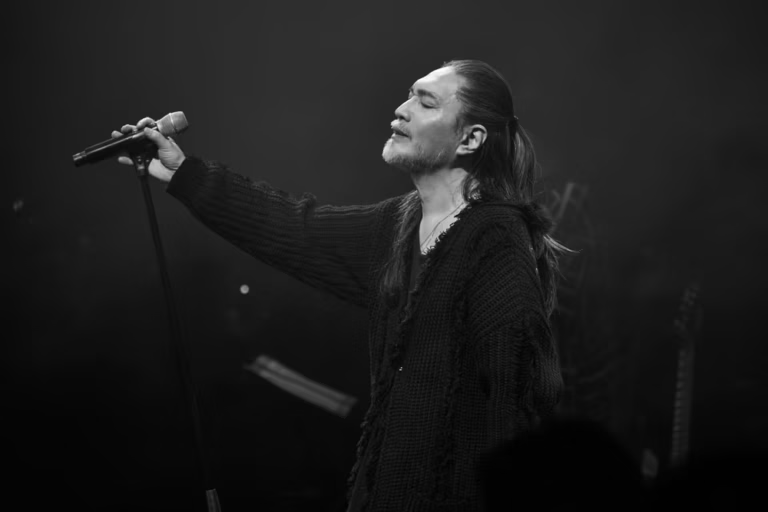
Lim Jae-beom, A Four Decade Resonance
Lim Jae-beom’s forty-year journey reveals how a single voice can hold the emotional rhythm of Korea.