Monami 153: A Pen Meant to Be Forgotten
Korean Everyday Icons #3
Open any drawer in Korea and you’ll probably find one. You don’t remember when you picked it up. Maybe it signed a lease. Or filled out a delivery form. Or added a name to a list.

The pen isn’t special. But it’s always there. Its name is Monami 153. Though most people forget that part.
Published April 30, 2025 — one day before the pen’s 62nd birthday.
Familiar, But Oddly New
In the spring of 1962, at an industrial fair in Seoul, a Korean businessman watched as a Japanese salesman pulled a pen from his pocket. No inkwell, no nib. Just a plastic-bodied pen that wrote without a fuss.

At the time, Koreans used fountain pens and ink bottles. Ballpoint pens were unknown.
The man, Song Sam-seok, took the pen back to his lab and took it apart. A tube of thick ink, a tiny rotating ball at the tip — nothing he couldn’t understand. What if they could make this here?
He soon flew to Japan and struck a deal with AUTO, the pen’s manufacturer. They wouldn’t give him everything — just enough. Oil-based ink formulas, yes. But the metal tips and balls had to be imported.
AUTO sent a technician to Korea for a month. Song and his team barely let him out of their sight. They watched, asked, documented, failed — again and again. Until finally, in May 1963, they got it right.

The Numbers Game
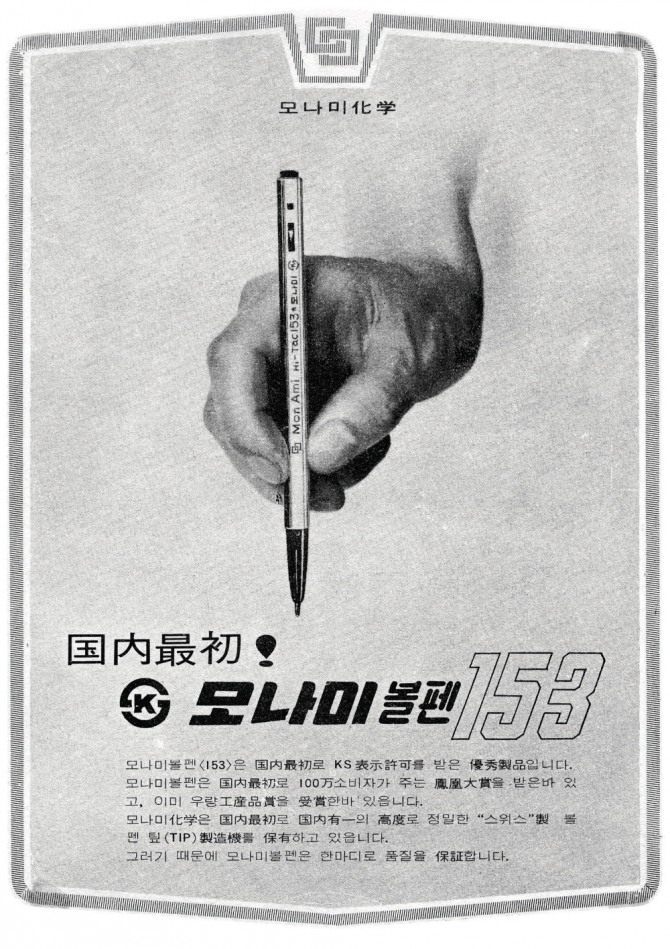
Why “153”? Officially, it stood for 15 won, the original price, and 3 — the company’s third product.
But myths emerged. In the Bible’s Gospel of John, 153 fish are caught in a single net — a symbol of abundance and providence, some said. Others claimed a more poetic origin: the release date — 1963, May 1st — forms 3-5-1. Flip it around, and you get 153. Coincidence or fate, it gave the pen an unlikely sense of meaning.
It Didn’t Sell
Not at first. People were skeptical. It didn’t look elegant. It didn’t feel familiar. Koreans didn’t want a pen they didn’t understand.
So Monami’s salesmen hit the streets. They gave out samples at banks and offices. Some even staged spills — knocking over cups of water on traditional ink documents, then rewriting them with the 153 to show its smudge-proof edge.
Slowly, minds changed. A few years later, the company changed its name too — from Gwangshin Chemical to simply… Monami. My friend.

A Copy, But Not a Knockoff
The pen’s design wasn’t original. It was based on the AUTO 326, a Japanese model from 1962. But this wasn’t about stealing a look. It was about solving a problem.
Korea didn’t need a perfect pen. It needed a pen people could afford, carry, and not worry about losing. Something simple enough to make, sturdy enough to keep, and cheap enough to replace. That’s exactly what the 153 became.
What Doesn’t Change, Lasts
The 153 hasn’t changed much in over sixty years. A hexagonal barrel to keep it from rolling. A retractable click. Three moving parts, maybe four.
It’s been called the AK-47 of pens — cheap, tough, and everywhere.
It’s been used not just for writing, but for everything else: extending worn-down pencils in art class, lengthening bus door switches, replacing nib holders in comics, even simulated emergency procedures in military drills. It’s less of a pen, and more of a tool. Its value isn’t in how it writes — it’s in how many ways it’s used.
One Day, It Became Cool
Then something strange happened. In 2013, for its 50th anniversary, Monami released a Limited Edition 153. Chrome-plated, weighty, premium. It sold out instantly.

What was once disposable was now desirable. Soon came more: pastel editions, DIY kits, museum collaborations, even a silver-plated model for Pope Francis.
Suddenly, the 153 wasn’t just a pen — it was a brand. Still cheap, yes. But now collectible. Still ordinary. But now, ironically, iconic.

Still Writing
The 153 has quietly filled out the paperwork of modern Korean life — residency forms, marriage certificates, job applications, delivery slips.
Its ink isn’t archival. Its body isn’t ergonomic. But that was never the point. It was always meant to be forgotten — which is precisely why it lasted.


Discover more from Kosmosis
Subscribe to get the latest posts sent to your email.


![[Korean Modern Art Series #1] The First Western Painters (1880–1930)](https://i0.wp.com/thekosmosis.com/wp-content/uploads/2025/10/OAQNAEERW5BB7OTNYAZYOABQYU.jpg?fit=768%2C514&ssl=1)