• From Balmain to Ramie: A Fashion Life, Rewoven in Korea

    How a London-trained designer left high fashion behind to weave culture, teaching, and tradition into a new kind of garment. I didn’t meet the designer by accident. In December last year, I drove down to Keimyung University in Daegu to meet Ali Ruth, who teaches fashion design there. That visit became the basis for a…
  • |

    1988: Sixteen Days That Changed Korea — and the World

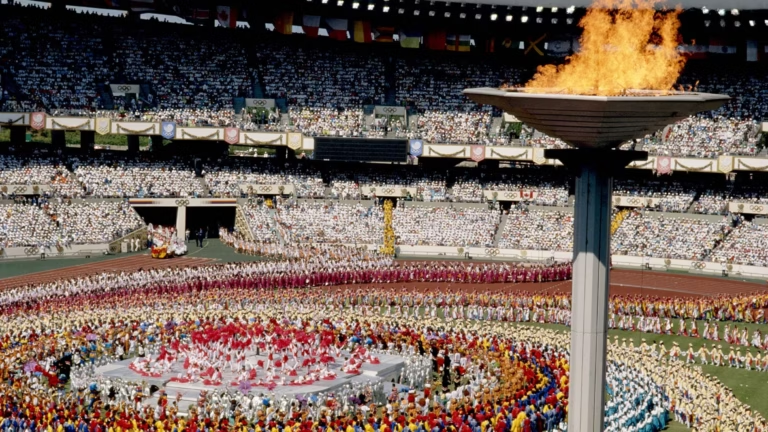
    How the Seoul Olympics became a symbol of national rebirth and global reordering No one expected Seoul to win. In the early 1980s, Nagoya seemed like the obvious choice to host the 1988 Summer Olympics. Japan had submitted its bid years earlier, while South Korea jumped in late, armed with little more than determination —…

  • |

    A Room of His Own: Chef Lee Joo-hwan’s D’asti Across Time

    “This isn’t a date-night pasta place. It’s where you show up in slippers and eat something honest.” A minute’s walk from Samgakji Station’s Exit 6, D’asti the Hidden faces an elementary school across the road — a quiet slice of the city where horns fade, children’s voices carry, and time feels slower. It’s calm here…

  • |

    Park Jiyoon: The Artist Who Took Korean Music from Gayo to K-Pop

    In 2000, one song would forever alter the course of Korean pop music. At the time, J.Y. Park was an emerging producer, fresh off the success of g.o.d, a group he had carefully crafted into a national sensation. With their emotional storytelling and melodic hooks, he had begun to define his signature style. But producing…

  • Binggrae Banana Milk

    Korean Everyday Icons #1 Binggrae’s Banana Flavored Milk has been a staple in Korean households for over 50 years, first introduced in June 1974 to encourage milk consumption at a time when dairy was unfamiliar to many Koreans. Bananas were an import-restricted luxury, making the banana-flavored milk an instant hit, offering both a new taste…

  • |

    On Hahoe Village and the Depth of Stillness

    하회 마을과 고즈넉함에 대하여 There’s a word in Korean—고즈넉함 (goznokahm)—that doesn’t quite translate into English. It’s a kind of peaceful stillness, one that feels full rather than empty. Quiet, but rich with meaning. It’s the kind of silence where time slows. A hanok’s wooden floors creaking in the afternoon sun. The distant sound of wind…

  • Daegu — A Journey Through Korea’s Layered Identity

    Where History Meets Modernity: Exploring Daegu’s Hidden Depths What began as an inspirational meeting with an artist breathing new life into traditional Korean textiles — ramie (모시) and hemp (삼베) — for modern wardrobes unfolded into a journey of discovery through Daegu’s layered identity. Daegu, the fourth-largest city in Korea and the capital of North Gyeongsang Province,…

  • Q&A with Seoul Goodman

    Meet the person behind Kosmosis Q: Who are you? A: I go by Seoul Goodman. It’s a pen name, a state of mind, and perhaps a quiet commitment to where I’m from. I’m a cultural storyteller focused on portraying Korea in ways that are emotionally honest, visually layered, and globally resonant. Q: Why did you…

  • The Most Korean Streetscape

    When I think about the most authentic Korean streetscape, it’s not the sleek landmarks designed by world-renowned architects, nor the hanoks, which, while cherished, are few in number. It’s the villas—the low-rise, multi-family buildings that have shaped Seoul’s residential fabric since the 1970s. Unlike high-rise apartment complexes, which feel closed off from the streets, villas…

  • |

    Chungmuro — Korea’s First Hollywood

    From the Silver Screen to Printing Presses: The Evolution of Korea’s Creative Heart In the 1950s and 60s, Chungmuro naturally became Korea’s film hub. Movie studios needed promotional materials — posters, scripts, brochures — and the print shops were already here, ready to meet the demand. This symbiotic relationship between filmmakers and printers gave birth…