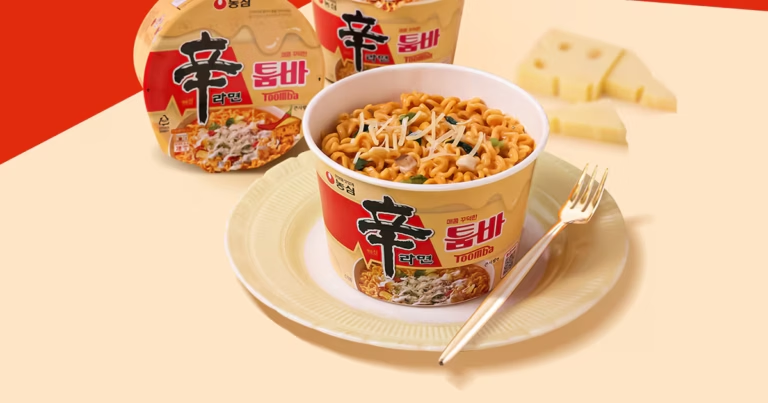
• How “Toowoomba” Became Korea’s Favorite Sauce

    To most Koreans, Toowoomba isn’t a foreign name. You’ll find it on instant noodles, hamburger steaks, and convenience store pastas across the country. Just yesterday at lunch, I ordered a “Toowoomba Hamburg” from a place in Pil-dong. It’s their signature dish. At this point, the name has become shorthand for a specific kind of flavor….

  • The Kosmosis Vol. 01 Has Launched

    The inaugural issue of The Kosmosis is now available. Titled Perspectives, Places and People., this 116-page English-language journal captures the overlooked beauty of everyday Korean life — from neighborhoods shaped by quiet resilience to the expressive forms of Korean Cool. Created by Seoul Goodman as a single-author publication, The Kosmosis is an independent quarterly journal…

  • |

    Americana Revisited: Tracing Korea’s Burger Memories from Ichon to Dogok

    In Dogok-dong, tucked behind a modest sign that simply reads “HAMBURGERS,” sits OneStar, a burger shop where the lighting, menu, and vinyl booths feel lifted from an earlier time. But this isn’t an accident. Everything here is intentional. Carefully curated. Thoughtfully branded. And, crucially, the food lives up to the mood. That, more than anything,…

  • A Touch of Ease: Nora Noh’s Style and the Roots of Korean Cool

    Pioneering Korean Fashion in the 1950s In 1956, Nora Noh hosted South Korea’s first fashion show at Seoul’s Bando Hotel, introducing modern styles for Korean women in a society still recovering from war. In an era when “fashion” itself was a novel concept in Korea, Nora Noh boldly stepped forward as the nation’s first fashion…

  • Chojeong Sparkling Water: Korea’s Badoit?

    It’s not every day you stumble across a naturally carbonated spring. In France, there’s Badoit. In Italy, San Pellegrino. These are more than just mineral waters — they’re bottled expressions of terroir, tradition, and time. And in Korea, there’s Chojeong. Tucked away in the countryside of Cheongju, Chojeong is home to a spring that has…

  • |

    Inside a Gisa Sikdang: A Driver’s Diner in Seoul

    At 7:30 a.m., most restaurants in the neighborhood were still closed. The only one open was a modest, old-school diner with a teal awning and an unmistakable name printed in red and blue: Bogwang Gisa Sikdang. A row of yellow plastic jugs and orange cones lined the front — a simple but effective way to…

  • #82C0DE, The Accent of Kosmosis

    When a hex becomes a story. When redesigning the site, I realized the previous accent color lacked intention. So I began searching — experimenting with HEX codes that could hold meaning as well as aesthetic value. Then came #82C0DE.It caught my eye, and then it made perfect sense. 82 for Korea.C0DE for structure, design, and…

  • Monami 153: A Pen Meant to Be Forgotten

    Korean Everyday Icons #3 Open any drawer in Korea and you’ll probably find one. You don’t remember when you picked it up. Maybe it signed a lease. Or filled out a delivery form. Or added a name to a list. The pen isn’t special. But it’s always there. Its name is Monami 153. Though most…

  • Gangneung: The City of Pines and Blue Tiles

    Where literature isn’t just remembered. It’s folded into daily life. Located on Korea’s eastern shore, Gangneung is a midsize coastal city in Gangwon Province, home to just over 200,000 residents. Nestled between the Taebaek Mountains and the East Sea, the city feels suspended between ridgelines and waves. As a sub-host city of the 2018 PyeongChang…

  • 1995: The Golden Year of Korean Music

    Before idols ruled the charts, Korean music hit its creative peak. Today, K-pop commands a global fanbase, captivating audiences across continents with synchronized performances and high-concept storytelling. But nearly 30 years ago, back in 1995, Korean pop music marked a very different kind of peak — a golden age that captured the spirit of a…