Slow takes and cultural essays that reframe how we see Korea: its aesthetics, contradictions, and transformations.

  • |

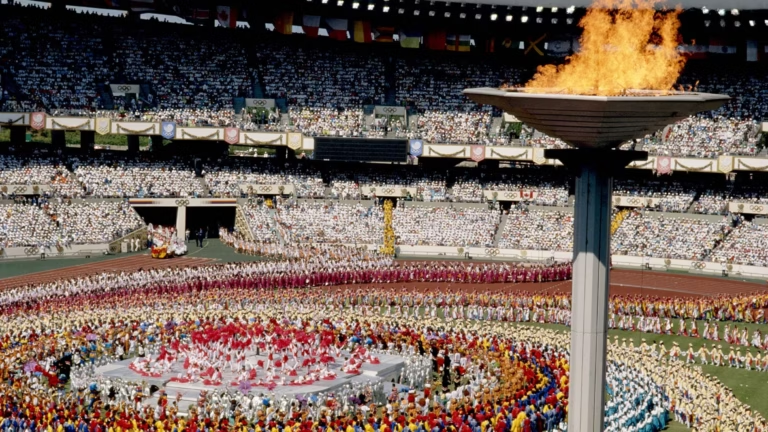
    1988: Sixteen Days That Changed Korea — and the World

    How the Seoul Olympics became a symbol of national rebirth and global reordering No one expected Seoul to win. In the early 1980s, Nagoya seemed like the obvious choice to host the 1988 Summer Olympics. Japan had submitted its bid years earlier, while South Korea jumped in late, armed with little more than determination —…

  • |

    Park Jiyoon: The Artist Who Took Korean Music from Gayo to K-Pop

    In 2000, one song would forever alter the course of Korean pop music. At the time, J.Y. Park was an emerging producer, fresh off the success of g.o.d, a group he had carefully crafted into a national sensation. With their emotional storytelling and melodic hooks, he had begun to define his signature style. But producing…

  • |

    On Hahoe Village and the Depth of Stillness

    하회 마을과 고즈넉함에 대하여 There’s a word in Korean—고즈넉함 (goznokahm)—that doesn’t quite translate into English. It’s a kind of peaceful stillness, one that feels full rather than empty. Quiet, but rich with meaning. It’s the kind of silence where time slows. A hanok’s wooden floors creaking in the afternoon sun. The distant sound of wind…

  • The Most Korean Streetscape

    When I think about the most authentic Korean streetscape, it’s not the sleek landmarks designed by world-renowned architects, nor the hanoks, which, while cherished, are few in number. It’s the villas—the low-rise, multi-family buildings that have shaped Seoul’s residential fabric since the 1970s. Unlike high-rise apartment complexes, which feel closed off from the streets, villas…

  • |

    Seongsu — the Heartbeat of Korean Cool

    Where Contradictions Collide to Create Korean Cool Recently, Seongsu was ranked as the 4th coolest neighborhood in the world by Time Out magazine in the UK. Like its nickname “Seoul’s Brooklyn,” Seongsu is a very dynamic space with a strong industrial feel, full of interesting discoveries, where people with diverse life trajectories move busily with…

  • Rethinking Korea’s Global Brand: What We’re Missing About Ourselves

    An Anthropological Perspective on Culture, Identity, and Storytelling I recently came across an insightful interview with Pauline Brown, former North American Chairman at LVMH, in Korea’s JoongAng Ilbo. In it, she describes Korea’s explosive global popularity — through K-Pop, K-Dramas, and K-Beauty — as akin to “sweet candy,” beloved globally yet at risk of losing momentum unless…