Park Jiyoon: The Artist Who Took Korean Music from Gayo to K-Pop
In 2000, one song would forever alter the course of Korean pop music.
At the time, J.Y. Park was an emerging producer, fresh off the success of g.o.d, a group he had carefully crafted into a national sensation. With their emotional storytelling and melodic hooks, he had begun to define his signature style. But producing for a five-member boy group was one thing—developing a solo artist, especially a female soloist, was an entirely different challenge.
That artist was Park Jiyoon 박지윤.
To bring his vision to life, J.Y. Park teamed up with a then-rising producer who went by the name The “Hitman” Bang—now known as Bang Si-hyuk, the architect behind HYBE and BTS. Together, they crafted an album that would challenge the norms of Korean pop and push the industry into a new era.
The result was Coming of Age Ceremony 성인식, a song that did more than just top the charts. It marked a fundamental shift in the way music was conceptualized, performed, and consumed in Korea. More than just a single, it was a meticulously designed statement—one that blurred the line between music and performance, redefining the very essence of what a K-pop act could be.
This was not just another song—it was a turning point.
This wasn’t just a performance—it was a bold, cohesive vision.
Every element of Coming of Age Ceremony worked together to create a transformative moment in Korean pop music. The lyrics, with lines like “I’m no longer a girl,” openly declared independence and self-empowerment, challenging societal norms in a way no Korean song had before. The music, hypnotic and provocative yet sophisticated, set the perfect foundation.
The choreography, deliberate and commanding, mirrored the song’s message of taking control, while the styling—sleek black attire with a daring slit, a bold short haircut, and sharp, defined makeup—exuded confidence and modernity. The look was elegant yet undeniably sensual, amplifying the song’s themes of transformation and self-possession. Park Jiyoon didn’t just perform; she delivered a statement.
Before this, Korean pop music—often referred to as Gayo—was diverse but followed familiar structures. Dance music and idol groups existed, but performances focused more on vocals or playful charm than fully realized concepts. But this performance marked a shift. It was when Korean pop music embraced the kind of fully integrated artistry—where music, choreography, and styling worked as one—that would define K-pop.
After the success of this album, J.Y. Park went on to produce artists like Rain and Wonder Girls, pushing this new era of K-pop forward. SM and YG Entertainment perfected the vision, bringing global attention to Korean music with artists like BoA and BIGBANG. K-pop had been evolving throughout the 1990s, shaped by Seo Taiji & Boys and first-generation idols like H.O.T. and Fin.K.L. But Coming of Age Ceremony showed just how powerful visual storytelling and performance-driven artistry could be, laying the groundwork for what K-pop would become.
Park Jiyoon had redefined what a solo female artist could be. But the same performance that propelled her to the top also became a cage. The industry refused to let her move beyond one moment, one image, one song.
J.Y. Park continued pushing creative boundaries, but the more she experimented, the clearer it became—she wasn’t in control of her own narrative. Man (2002) featured androgynous styling, Twenty One (2003) faced controversy over its lyrics, but the public wasn’t ready for Park Jiyoon to be anything other than the Coming of Age Ceremony singer.
So in 2003, at just 21 years old, she walked away.
She left JYP, turned her back on the K-pop machine, and disappeared from the industry for years. No comeback, no explanation. The girl who had defined a generation of pop music simply vanished.
And then, in 2009, she returned.
But not as the person the industry had once shaped.
This was not a comeback in the K-pop sense. There were no choreographed performances, no grand promotional rollouts, no industry-driven reinvention.
Instead, Park Jiyoon re-emerged with 꽃, 다시 첫 번째 (Flower, Again for the First Time)—a self-produced, indie-folk album that felt like the opposite of everything she had done before.
For the first time, she wasn’t performing someone else’s vision. She was writing her own music, telling her own story.
Gone was the high-concept spectacle. What remained was the artist.

Today, I took out my CDs again. It had been a long time since I last thought about those years. Back then, in my apartment in Rome, Blue Angel was in heavy rotation. That album was one of my favorites.
In those two decades, she moved on from Coming of Age Ceremony, walked away from the world that defined her, and spent years rebuilding herself as an artist. I, too, spent that time forging my own path, navigating the years in pursuit of something that was mine. Now, two decades later, I find myself writing about her impact on K-pop—a moment I never imagined back then.
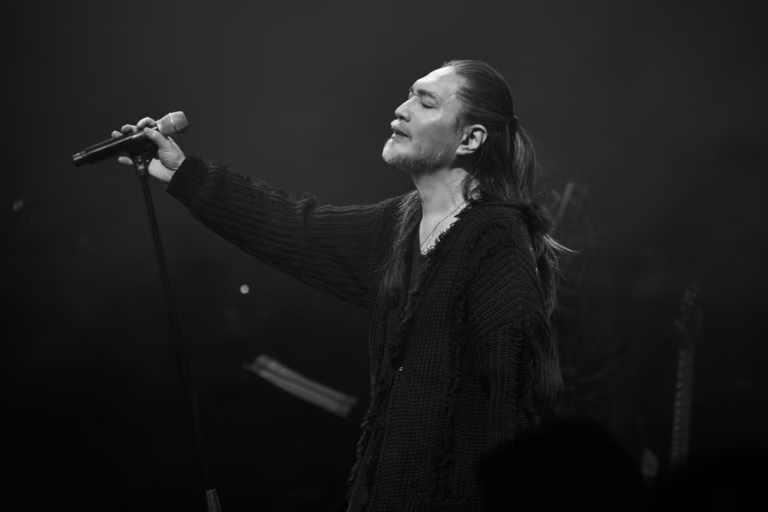
It feels right to end this with Park Jiyoon singing Illusion in 2024—another defining song from her fourth album. It was still the same song, but something had changed. Like a fine wine, she had deepened with time—more refined, more expressive, more profound.
Discover more from Kosmosis
Subscribe to get the latest posts sent to your email.