

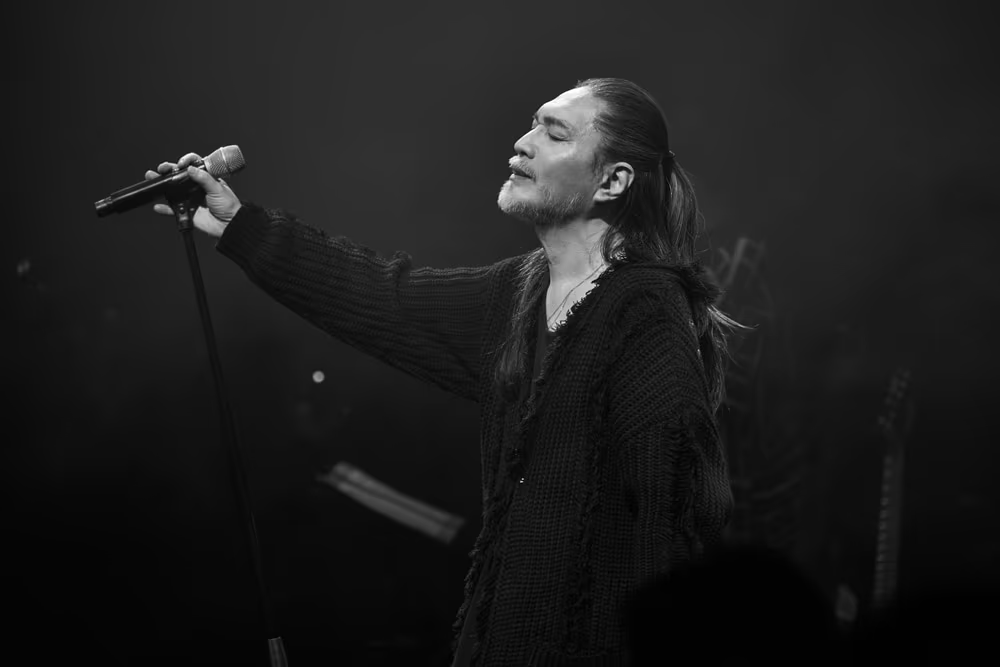
Lim Jae-beom, A Four Decade Resonance
한국어 버전은 영어 본문 뒤에 이어집니다.
Some voices do more than impress. They redraw the emotional lines of those who listen. The voice of Lim Jae-beom is one of them. He is an artist who has shaped his path not through trends but through the force and honesty of his sound. Often compared to Michael Bolton or James Ingram for his power and emotional weight, his music ultimately belongs to a world formed by the emotional soil of Korea.
Lim began his career in 1986 as the vocalist of Sinawe, a band widely regarded as the starting point of Korean heavy metal. His unfiltered, abrasive tone left a strong imprint on the scene. After moving through several rock bands, he turned to a solo career in 1991, revealing a voice with far greater expressive depth. Some early peers did not entirely welcome his stylistic shift, but that transition became a decisive step toward the sound that defines him today.


A 1991 live performance of When This Night Passes remains one of the clearest portrayals of his early identity. At thirty, he stood onstage with a voice that was not polished but unmistakably alive. The performance carries the tension of a young singer oscillating between metal and ballad sensibilities, along with the emotional density that would later become a hallmark of his work.
The emotional structure of Lim’s voice can be read through the Korean framework of han, jeong, and heung, introduced in a previous essay in The Kosmosis.
Han is an unresolved depth that lies beneath the surface.
Jeong is the lingering resonance that remains after emotion passes.
Heung is the upward surge, an energy that breaks open what has been held inside.
Lim’s singing shows how these sentiments can merge into a single emotional texture. In Confession, they do not appear as separate stages but as overlapping movements. Han forms the ground of the song, giving it weight. Heung rises in the final outpouring, opening what has been suppressed. Jeong settles after the voice falls, becoming the lingering echo that completes the piece.
There were long periods when Lim stepped away from the public eye. Yet that time did not create absence. It seeped into his voice, forming another layer of texture. When he returned, audiences encountered not a comeback but a voice shaped by years of holding, enduring, and quietly deepening.
He often says he inevitably finds his way back to music, as if something continually pulls him toward it. Rooted in rock, his voice absorbs influences in a way that feels organic, creating a sound defined less by genre than by the texture of his emotion.

In 2025, Lim is touring across Korea to mark the 40th anniversary of his debut. Beginning in Daegu and continuing through cities such as Incheon, Busan, Suwon, and Goyang, the tour retraces the full arc of his musical life. These concerts are not repetitions of the past. They are confirmations of a voice that remains firmly alive. His creative work also continues. Two songs from his upcoming eighth album have already been released, signaling that this milestone is not a closing chapter but another beginning.
Lim Jae-beom remains one of the clearest resonances in Korean music. Listening to him is not simply hearing a song. It is entering the emotional strata of a culture. Within his voice, han, heung, and jeong still move together, and when he sings, these emotions return as a single unmistakable wave.
임재범, 40년의 울림
어떤 목소리는 단순한 감동을 넘어 듣는 이의 감정선을 다시 그린다. 임재범의 목소리가 그렇다. 그는 유행의 방향과 무관하게, 목소리의 힘과 정직함만으로 자기만의 길을 만들어온 아티스트다. 압도적인 성량과 감정의 밀도로 인해 종종 마이클 볼튼이나 제임스 잉그램과 비교되지만, 그의 음악은 결국 한국이라는 정서적 토양에서 탄생한 고유한 세계에 놓여 있다.
임재범은 1986년 시나위의 보컬로 데뷔했다. 시나위는 한국 헤비메탈의 시작을 연 밴드였고, 그의 거칠고 숨기지 않은 음색은 그 장면에 강한 흔적을 남겼다. 여러 록 밴드를 거친 뒤 1991년에 솔로로 전향하며 비로소 그의 표현력이 온전히 드러났다. 이 과정에서 스타일을 바꾼 그의 선택을 초창기 동료들이 마냥 반기지는 않았다고 전해지지만, 바로 그 전환이 오늘 우리가 알고 있는 임재범이라는 목소리를 완성하는 데 결정적인 계기가 되었다.
1991년 방송된 “이밤이 지나면” 라이브 무대는 그의 초기 정체성을 가장 또렷하게 보여주는 장면이다. 당시 서른 살의 그는 다듬어지지 않았지만 살아 있는 목소리로 무대에 섰다. 그 퍼포먼스에는 메탈과 발라드 사이를 오가던 젊은 시절의 긴장감, 그리고 나중에 그의 음악을 규정하게 될 감정의 밀도가 고스란히 담겨 있다.
임재범의 목소리를 이루는 정서는 한국인의 감정 구조인 한, 정, 흥을 통해 더 분명히 읽힌다. 이 감정 구조는 한국적 정서의 문법을 다룬 The Kosmosis의 이전 칼럼에서도 소개한 바 있다.
“한”은 표면 아래 가라앉아 있는 해결되지 않은 깊이다.
“정”은 감정이 지나간 뒤에도 오래 머무는 여운이다.
“흥”은 고요를 깨고 치고 올라오는 에너지의 분출이다.
임재범의 노래는 이 감정들이 어떻게 하나의 결로 묶일 수 있는지를 보여준다. “고해”에서 이 감정들은 나란히 놓인 단계가 아니라, 서로 겹쳐 움직이는 결로 드러난다. 한은 곡의 바닥을 만들며 깊이를 주고, 흥은 마지막 순간에 치밀어 올라 억눌려 있던 감정을 열어젖히며 정점을 만든다. 정은 목소리가 멈춘 뒤에도 남아 흐르는 여운이 되어 곡을 완성한다.
그에게는 대중 앞에서 오랜 시간 멀어져 있던 시기도 있었다. 그러나 그 시간은 부재가 아니라 그의 목소리 안으로 천천히 스며들며 또 다른 결을 만든 세월이었다. 그가 돌아왔을 때, 관객이 마주한 것은 단순한 복귀가 아니라 시간을 견딘 사람만이 낼 수 있는 목소리였다.
그는 종종 자신이 결국 음악으로 돌아오게 된다고 말한다. 마치 어떤 힘이 언제나 그를 다시 이끌어오는 듯하다. 록에 뿌리를 두고 있지만, 그의 목소리는 다양한 영향들을 자연스럽게 흡수하며 장르보다 감정의 질감으로 정의되는 소리를 만든다.
2025년, 임재범은 데뷔 40주년을 맞아 전국 투어를 진행하고 있다. 대구를 시작으로 인천, 부산, 수원, 고양 등 여러 도시에서 그의 40년 음악 여정을 다시 펼치고 있다. 이번 공연은 과거를 되풀이하는 자리가 아니라, 여전히 현재형으로 존재하는 목소리를 확인하는 순간들이다. 그의 창작 또한 움직임을 멈추지 않았다. 현재 작업 중인 8집에 실릴 두 곡이 이미 발표되었고, 이 프로젝트는 이번 기념 공연이 끝이 아니라 또 다른 시작임을 보여준다.
임재범의 목소리는 한국 대중음악에서 가장 선명한 울림 중 하나다. 그의 노래를 듣는 일은 단순한 감상이 아니라, 한국이라는 문화가 품어온 감정의 지층을 더듬는 경험에 가깝다. 그 안에는 지금도 한이 있고, 흥이 있고, 정이 있다. 그리고 그 목소리가 열리는 순간, 이 세 감정은 하나의 파동이 되어 되돌아온다.

![[Korean Modern Art Series #4] From Informel to Dansaekhwa (1956–1980)](https://thekosmosis.com/wp-content/uploads/2025/11/점으로부터.avif)


