

[Korean Modern Art Series #4] From Informel to Dansaekhwa (1956–1980)
This article concludes The Kosmosis’s four-part series on modern Korean art — tracing its journey from the first Western painters to abstraction, and from postwar turbulence to the stillness of Dansaekhwa.
Modern Korean art after the war was born out of ruins. In the mid-1950s, a new generation of painters began to confront the chaos of their time through abstraction. The raw, emotional energy of Informel painting became a means to express survival and despair, a visual language that captured both the turbulence of postwar Korea and the search for renewal.
By the 1970s, this intensity gave way to quietude. The same generation turned inward, transforming the material aggression of Informel into the meditative calm of Dansaekhwa. What began as a cry of anguish evolved into silence and contemplation. This passage — from matter to mind, from gesture to reflection — marks one of the most profound transitions in modern Korean art.

Korean Informel: Painting After the War (1956–1965)
The story begins in 1956, with the founding of the Contemporary Artists Association (현대미술가협회). It was a group of young painters determined to escape academic conventions and embrace postwar modernism. In their second exhibition of 1957, Informel and Abstract Expressionist styles appeared for the first time in Korea. These artists, influenced by Jackson Pollock and European avant-garde tendencies, expressed the psychological tension, trauma, and uncertainty of a nation recovering from war.
Their non-formal compositions linked the spontaneity of Art Informel with the rebellious spirit of Dada, turning abstraction into resistance, a cry against structure, reason, and order. For the first time, Korean art entered the global modernist dialogue not through imitation but through shared emotional and existential ground.
In the years that followed, new collectives expanded this frontier. The Wall Group (벽 동인), founded by Seoul National University graduates in 1958, staged unauthorized outdoor exhibitions along Deoksugung’s western wall. It was a radical act that broke art free from institutional spaces. Meanwhile, the 1960 Artists Association (60년 미술가협회), composed largely of Hongik and Seoul National alumni, held exhibitions along the northern wall, forming a symbolic axis of avant-garde Seoul.

In 1962, the two major groups, the Contemporary Artists Association and the 1960 Artists Association, merged to form ACTUEL (악뛰엘). It marked the birth of a truly international outlook in Korean art. Their work moved beyond Western mimicry to seek inner meaning and Eastern identity, paving the way for a uniquely Korean modernism.
Park Seo-bo (1931–2024)
Park emerged as one of the key figures of Informel and the father of Dansaekhwa. In the late 1950s, his early canvases exploded with impasto, scraps, and violent brushwork, gestures of anguish reflecting war’s psychic wounds. Newspapers even captured him mid-action, wielding his brush in a frenzy reminiscent of Pollock. He attached found objects to his canvases, layered pigment like debris, and turned painting into a physical, almost performative act.

By the late 1960s, Park’s energy turned inward. He abandoned gestural chaos for a quiet, repetitive discipline. His lifelong Ecriture (묘법) series began with pencil lines drawn across layers of wet paint, inspired by his son’s school notebook. The work became a meditative practice rooted in mu-a-jigyong (無我之境), a state of self-forgetting achieved through rhythmic repetition.
“To repeat is to purify. To paint is to empty oneself.”
— Park Seo-bo, Ecriture, White Cube Gallery, London, 2016
Through Ecriture, Park bridged Western minimalism and Eastern meditation, transforming painting into a disciplined act of mindfulness, a practice of mu-a (無我), or self-effacement.

Kim Tschang-yeul (1929–2021)
A founding member of the first Contemporary Art Exhibition, Kim pioneered Korean Informel before evolving into lyrical minimalism. In the 1960s, he moved to New York at Kim Whanki’s invitation, met Nam-June Paik, and was exposed to the experimental energy of the Fluxus movement. He later settled in France, where life was harsh, working in a cold stable on the outskirts of Paris, living and painting with a single stove for warmth.

From that solitude came his defining series, Water Drops. They were not decorative illusions but acts of redemption, his blood, sweat, and tears transformed into light.
“For Kim, each water drop was a vessel of reflection and memory, a way to let go of desire and pain through painting.”
— Kim Tschang-yeul, MMCA Retrospective Catalogue, 1993

Kim, who had studied both calligraphy and drawing in his youth, infused his work with duality, structure and intuition, East and West. His early Rites (제사) series mourned his younger sister’s wartime death, while his Water Drops embodied rebirth through stillness. In later years, he painted drops over Chinese characters and even newspaper pages, reuniting image and language, illusion and matter, his early Informel energy transformed into quiet contemplation.
Yun Myeong-ro (b. 1936)
A member of the 1960 Artists Association, Yun’s early paintings carried the weight of existential literature and Eastern mysticism. His Wall A and Wall B, inspired by Sartre’s The Wall, won top honors at the National Art Exhibition, marking the first mainstream recognition of Informel-inspired abstraction in Korea.
Later, Yun explored cement, sand, and pigment as sculptural surfaces. His Crack (균열) series, defined by fissures and melted traces, reflects a yearning for healing amid fragmentation. In his Entwining (얼레짓) paintings, he translated the act of winding and releasing string into a metaphor for emotion, binding, loosening, and reconciling.

From Matter to Mind: Dansaekhwa (1970–1980)
By the 1970s, the violence of material expression softened into introspection. What followed was Dansaekhwa, Korea’s monochrome abstraction. Although the term Dansaekhwa (단색화) was coined only in 2012 by critic Yoon Jin-sup, the movement defined the 1970s with its meditative materiality and philosophical restraint.
Art critic Lee Il once wrote:
“White is not a color, but a state of being, a field of possibility where the universe comes into form.”
The essence of Dansaekhwa lay in tactility, spirituality, and process:
the material presence of hanji or hemp,
the artist’s repetitive discipline as a form of self-cultivation,
and the merging of body and surface into a single temporal flow.
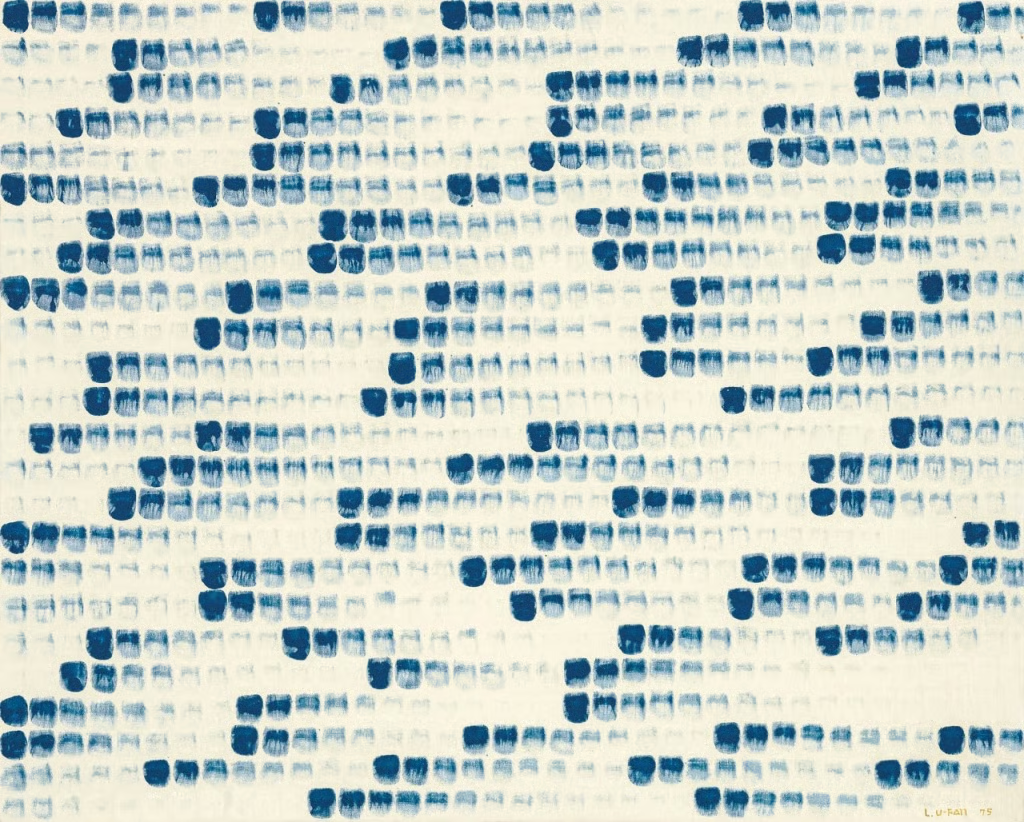
Lee Ufan (b. 1936)
Philosopher, writer, and artist, Lee bridged Korea’s Dansaekhwa and Japan’s Mono-ha (“School of Things”). While Park Seo-bo sought unity with nature, Lee sought the dissolution of self through object and relation. Rejecting anthropocentrism, he proposed an aesthetic of beyond modernity, allowing meaning to arise through encounter rather than control.

In the late 1960s, Lee began creating sculptures that he called Relatum — a term meaning “that which exists only in relation.” Each work placed natural stones in tension with industrial materials such as steel or glass, revealing not the objects themselves but the invisible field of relationships between them. For Lee, art was not about form or expression, but about the moment when things, spaces, and viewers encounter one another. This philosophy of encounter extended naturally into his paintings like From Point and From Line, where repetition and disappearance expressed the rhythm of time and being.

“The brush moves, then stops. In that silence, meaning arises.”
— Lee Ufan, paraphrased from The Art of Encounter
He called this the art of mu-wee (無爲), a practice of letting the world reveal itself through restraint.
Legacy and Reflection

Dansaekhwa brought together Western minimalism and Eastern metaphysics, turning painting into philosophy. It was, as critic Kim Youngna observed,
“the first movement to engage with global modernism while asserting Korean identity.”
Others saw in it a more complex truth. Critic Jeong Heon described it as “art of silence,” complicit in the era’s authoritarian conformity. Yoon Nan-ji called it “a male-centered art of privilege,” while others viewed it as an introspective retreat from social reality.
Yet beyond ideology, Dansaekhwa remains the most profound expression of a generation that turned chaos into calm, artists who transformed matter into meditation, and painting into prayer.
 Kim Tschang-yeul
 Park Seo-bo
 Lee Ufan
_
Note: This article was written based on the lecture “Scenes of the Firsts in Korean Modern Art” by the Seoul Arts and Culture Education Center.
엥포르멜에서 단색화로 (1956–1980)
본 글은 한국 근대미술을 조명한 4부작 시리즈의 마지막 편으로, 서양화의 도입에서 추상, 그리고 단색화에 이르는 여정을 마무리한다.
전쟁 이후, 한국 추상의 두 번째 탄생
한국전쟁 이후, 잿더미 위에서 새로운 미술이 태어났다.
1950년대 중반, 젊은 화가들은 서양 추상미술의 언어를 빌려 전쟁의 상처와 불안을 표현하기 시작했다. 1956년 결성된 현대미술가협회는 그 출발점이었다. 이듬해 두 번째 전시회에서 처음으로 엥포르멜 양식이 대거 등장하며, 한국 현대미술의 본격적인 전환이 시작됐다.
이들은 서구의 추상표현주의와 엥포르멜 미술 양쪽에서 영향을 받았다. 잭슨 폴록의 액션 페인팅처럼, 화면을 감정의 장으로 보고 내면의 에너지를 붓질과 물감의 중첩으로 폭발시켰다. 거칠고 뜨거운 마티에르의 질감 속에는 전후의 혼란, 절망, 그리고 다시 일어서려는 생존의 의지가 담겨 있었다. 다다이즘의 저항 정신이 한국적 실존의 감정과 결합하며, 미술은 다시 “살아 있는 행위”가 되었다.
이후 벽 동인과 60년 미술가협회가 결성되며 전위적 실험이 활발히 이어졌다. 덕수궁 돌담길 벽면에 각각 작품을 전시했던 이들은 “미술의 고상함”을 깨뜨리고 거리로 나온 첫 세대였다. 이 흐름은 곧 악뛰엘(Actuel)이라는 연합으로 이어지며, 한국 미술이 서구의 모방을 넘어 국제적 대화 속 주체적 표현을 탐색하던 시기를 열었다.
⸻
박서보: “반복은 정화다. 그리기는 비우기의 과정이다.”
한국 아방가르드의 선구자이자 단색화의 중심 인물인 박서보(1931–2023) 의 초기 작품들은 전쟁의 상처와 불안, 고독을 거칠게 드러낸 엥포르멜 회화였다. 캔버스에 폐자재를 붙이고 물감을 두껍게 쌓아 올린 그의 화면은 당시 신문에서 “한국의 폴록”이라 불리기도 했다.
1960년대 후반 이후 그는 묘법(Ecriture) 연작으로 전환하며 붓의 행위를 수행처럼 반복하는 새로운 회화 세계를 열었다. 박서보에게 그림은 표현이 아니라 호흡이었다. 그는 이렇게 말했다.
“반복은 정화다. 그리기는 비우기의 과정이다.”
— 박서보,《박서보 묘법》, 학고재, 2000
그의 회화는 서구의 미니멀리즘을 한국적으로 해석한 결과였다. 물감층 위에 연필로 선을 긋고, 다시 긋고, 또 긋는 과정 속에서 그는 자아를 비우고 무심(無心)에 이르는 ‘무아(無我, mu-a)’의 경지를 추구했다. 이 수행적 반복은 화면과 몸, 호흡을 하나로 묶어 주는 방법이었다. 초기에는 마포에 단색 유화를 칠하고 연필로 선을 중첩했으며, 이후에는 한지 위로 리듬을 새겨 물질성과 호흡의 밀도를 드러냈다.
⸻
김창열: “물방울은 나 자신이며, 동시에 나를 지우는 존재다.”
김창열(1929–2021) 은 한국 엥포르멜 1세대이자 물방울 회화로 세계 미술사에 이름을 남긴 작가다. 전쟁 중에 가족을 잃은 그는 한때 “제사”를 주제로 한 그림을 그리며 존재와 죽음, 애도의 감정을 화폭에 담았다.
1960년대 후반, 그는 뉴욕을 거쳐 파리로 건너갔다. 난방조차 되지 않던 마굿간 작업실에서 그는 우연히 캔버스 위에 떨어진 물방울 자국을 보고 새로운 영감을 얻었다. 이후 평생을 이어간 물방울 시리즈는 단순한 시각적 장식이 아니라, 고통과 수행, 그리고 존재의 투명함을 상징했다.
“나는 물방울을 그리며 나를 비운다.”
— 김창열, 《국립현대미술관 회고전 도록》, 1993
평론가 도미니크 데뷔(Dominique Davy)는 그의 작업을 두고 이렇게 썼다.
“In Kim’s paintings, a drop of water becomes the origin of all things, containing reflection, time, and the self.”
— Galerie Boudin Lebon, Paris, 1994
그의 후기에는 물방울 속에 서예의 획, 한자, 신문지 등 삶과 기억의 흔적이 겹쳐지며 물질과 환상의 경계를 허무는 명상적 세계로 확장되었다.
⸻
윤명로: 균열 속의 치유를 그린 화가
윤명로(1936– ) 는 1960년대 60년 미술가협회 출신으로, 서양 추상화와 동양적 정신성을 결합한 대표적 작가다. 초기작 〈벽 A〉 와 〈벽 B〉 는 사르트르의 소설 『벽』에 영감을 받은 작품으로, 엥포르멜 추상이 처음으로 국전에서 특선을 수상한 역사적 순간이었다.
그의 작업은 시대의 불안 속에서 인간의 근원적인 감정과 문명의 원초적 상태를 탐구했다. 후기에는 〈균열〉 연작을 통해 캔버스 위에 남은 갈라짐과 흠집, 녹아내림의 흔적을 치유와 회복의 상징으로 재해석했다. 또 다른 시기에는 〈얼레짓〉 시리즈에서 마음을 감고 푸는 행위의 흔적을 회화적 리듬으로 옮겼다.
⸻
이우환: 사물과 세계의 관계를 탐구한 철학자이자 화가
이우환(1936– ) 은 한국에서 미술을 공부한 뒤 일본으로 건너가 철학을 전공했다. 그곳에서 그는 “근대초극론”의 사유를 통해 인간 중심의 시선을 비판하고, 사물 그 자체의 존재와 그것이 놓인 관계에 주목했다. 이 생각은 곧 일본 미술운동 ‘모노하(物派, School of Things)’의 이론적 토대가 된다. 그에게 중요한 것은 사물 그 자체가 아니라, 사물과 사물 사이, 그리고 사물과 공간, 사물과 관찰자 사이에서 생겨나는 긴장과 조화였다.
그는 이 철학을 〈관계항 Relatum〉 연작으로 시각화했다. 돌과 유리판, 철판과 고무자 같은 단순한 오브제들을 배치하며,
각 물체의 물성과 그 사이의 간격이 스스로 의미를 드러내게 했다. 그는 이를 “무위(無爲, mu-wee)의 예술”, 즉 억지로 하지 않음으로써 세계가 스스로 드러나는 상태라 불렀다.
“붓이 움직일 때보다 멈추는 순간이 더 중요하다. 그 멈춤 속에서 세계와 내가 만난다.”
— 《만남을 찾아서》, 열화당, 1991
회화에서도 그는 동일한 태도를 이어갔다. 〈점으로부터〉, 〈선으로부터〉 연작에서 그는 붓을 들고 천천히 한 점, 한 선씩 찍거나 그으며, 점이 사라지고 선이 희미해질 때까지 그 과정을 반복했다. 그리기의 행위는 의식의 통제가 아니라 시간과 존재의 흐름이 되었다.
이우환의 예술은 결국 ‘나’라는 존재를 비우고 사물과 세계 속으로 들어가는 길이었다. 그의 침묵은 무관심이 아니라 존재의 깊이를 향한 성찰이었다.
⸻
단색화, 한국적 모더니즘의 완성
1970년대 이후, 박서보, 윤명로, 김창열, 이우환을 비롯한 작가들은 엥포르멜의 뜨거운 에너지를 정제된 사유로 전환하며 한국적 미니멀리즘인 단색화(Dansaekhwa) 를 확립했다.
단색화는 화면과 재료, 행위가 하나가 되는 회화였다. 한지, 마포, 물감의 물질성을 탐구하고 반복적 행위를 통해 정신적 몰입에 도달했다. 서구의 미니멀리즘이 형태의 절제를 추구했다면, 단색화는 정신의 절제를 추구했다.
미술평론가 이일은 이렇게 말했다.
“백색은 빛깔이기 이전에 하나의 정신이다. 하나의 우주이며, 스스로를 구현하는 모든 가능성의 생성의 마당이다.”
단색화는 회화의 근본을 탐구하면서도, 동양적 사유와 수행적 행위를 통해 한국 미술이 국제적 언어로 자리 잡을 수 있음을 증명했다.
⸻
에필로그: 혼돈에서 침묵으로
1950년대의 엥포르멜이 전쟁의 상처와 혼란을 토해냈다면, 1970년대의 단색화는 그 상처를 고요히 감싸 안았다.
물질에서 정신으로, 제스처에서 사유로, 그 변화의 궤적 속에서 한국 현대미술은 비로소 자신만의 언어를 갖게 되었다.
_
주석: 본 글은 서울문화예술교육센터의「한국 근현대미술, 최초의 장면들」강의를 바탕으로 작성되었습니다.


![[Korean Modern Art Series #3] The Birth of Abstraction (1950-70)](https://i0.wp.com/thekosmosis.com/wp-content/uploads/2025/10/%EA%B9%80%ED%99%98%EA%B8%B0-%ED%95%AD%EC%95%84%EB%A6%AC%EC%99%80-%EC%97%AC%EC%9D%B8%EB%93%A4-1.jpg?fit=768%2C380&ssl=1)

