How “Toowoomba” Became Korea’s Favorite Sauce

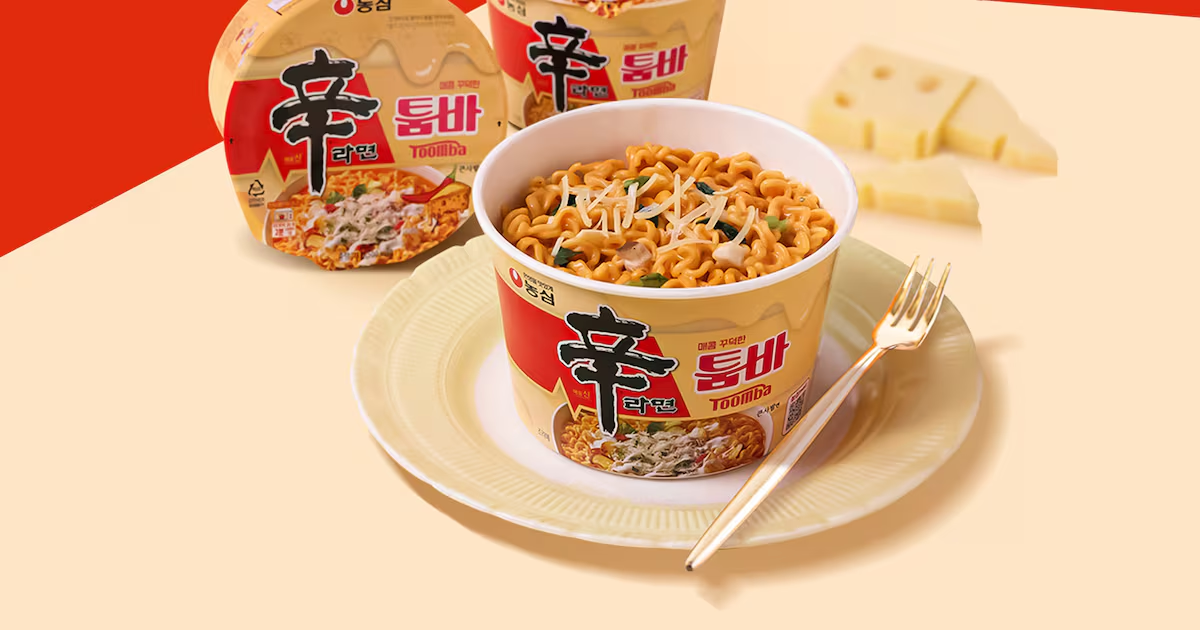
To most Koreans, Toowoomba isn’t a foreign name. You’ll find it on instant noodles, hamburger steaks, and convenience store pastas across the country. Just yesterday at lunch, I ordered a “Toowoomba Hamburg” from a place in Pil-dong. It’s their signature dish.

A Toowoomba Hamburg steak from Pildong Hambak.
The shrimp and cream sauce now lives far from its namesake town.

At this point, the name has become shorthand for a specific kind of flavor. Creamy, spicy, slightly garlicky, usually with shrimp, and unmistakably Korean in its final form. But few ever stop to ask: where exactly is Toowoomba?

The real Toowoomba is a small inland city in Queensland, Australia. A town known more for flower festivals and dry air than for seafood. It’s one of the few major Australian cities with no access to the sea. Which makes it all the more absurd, in the best way, that in Korea, Toowoomba has come to mean a shrimp-laden cream pasta.

Toowoomba’s place on the map. An inland city with no coastline, yet somehow lending its name to Korea’s most popular seafood pasta.

The dish first appeared at Outback Steakhouse. Despite the name, Outback isn’t an Australian brand. It’s American, built on a fantasy of what Australians might eat, imagined by U.S. marketers in the 1980s. In Korea, it worked. The branding took root. The steaks sold. And somewhere along the way, this peculiar “Toowoomba Pasta” appeared on the menu.

Creamy and rich, with chili flakes, soy sauce, and a generous helping of garlic, it was a remix of Italian, Korean, and something else entirely. It wasn’t authentic. Not to Australia, not to Italy, not to anyone’s grandma. But it was delicious. Korean diners fell hard for it.

Other family restaurant chains from that era eventually faded. TGI Fridays, Bennigan’s, Tony Roma’s. But Outback stayed alive. And much of that staying power had to do with Toowoomba. The dish became a kind of anchor. A signature. A survival tactic disguised as comfort food.

Outback’s iconic Toowoomba Pasta. Born in a fantasy of Australia, perfected in Korean mouths. First launched in 2006.

Now, the name lives on far beyond the restaurant that made it famous. It’s a sauce. A flavor. A stand-in for a craving that can’t quite be explained. Toowoomba is no longer just a place. In Korea, it’s part of the everyday menu.

I often wonder if the people living in Toowoomba know. That their dry, landlocked city has given its name to a beloved Korean pasta. That the word Toowoomba might appear more often in Seoul convenience stores than in Australian conversations.

Toowoomba, Queensland. A landlocked Australian town now unintentionally famous for a shrimp cream pasta in Korea.

But that’s how it goes sometimes. A stray word travels halfway across the world. Lands in the right mouth. And stays.

Similar Posts

  • The Kosmosis Vol. 01 Has Launched

    The inaugural issue of The Kosmosis is now available. Titled Perspectives, Places and People., this 116-page English-language journal captures the overlooked beauty of everyday Korean life — from neighborhoods shaped by quiet resilience to the expressive forms of Korean Cool. Created by Seoul Goodman as a single-author publication, The Kosmosis is an independent quarterly journal…

  • Chojeong Sparkling Water: Korea’s Badoit?

    It’s not every day you stumble across a naturally carbonated spring. In France, there’s Badoit. In Italy, San Pellegrino. These are more than just mineral waters — they’re bottled expressions of terroir, tradition, and time. And in Korea, there’s Chojeong. Tucked away in the countryside of Cheongju, Chojeong is home to a spring that has…

  • Daegu — A Journey Through Korea’s Layered Identity

    Where History Meets Modernity: Exploring Daegu’s Hidden Depths What began as an inspirational meeting with an artist breathing new life into traditional Korean textiles — ramie (모시) and hemp (삼베) — for modern wardrobes unfolded into a journey of discovery through Daegu’s layered identity. Daegu, the fourth-largest city in Korea and the capital of North Gyeongsang Province,…

  • Korean Beef 101: A Cut Above the Rest

    A Practical Guide for Foreigners This comprehensive guide is designed to help foreigners better understand the various parts of Korean beef cuts. With this knowledge, you’ll be able to make more informed choices when purchasing beef from Korean supermarkets or ordering dishes at Korean restaurants. Whether you’re an expat living in Korea, a traveler exploring…

  • 1995: The Golden Year of Korean Music

    Before idols ruled the charts, Korean music hit its creative peak. Today, K-pop commands a global fanbase, captivating audiences across continents with synchronized performances and high-concept storytelling. But nearly 30 years ago, back in 1995, Korean pop music marked a very different kind of peak — a golden age that captured the spirit of a…

  • |

    Inside a Gisa Sikdang: A Driver’s Diner in Seoul

    At 7:30 a.m., most restaurants in the neighborhood were still closed. The only one open was a modest, old-school diner with a teal awning and an unmistakable name printed in red and blue: Bogwang Gisa Sikdang. A row of yellow plastic jugs and orange cones lined the front — a simple but effective way to…