Rootless Seoul: Why We Need Memories Over Landmarks
서울은 새로운 랜드마크가 필요 없습니다. 우리에게 필요한 건 땅의 기억, 바로 ‘터무늬’입니다.
Seoul doesn’t need new landmarks. We need ‘Teomunui’: the true patterns of the land. It’s about finding the ‘Top Feels’, not just ‘Top Places’.


Contextual pieces that decode how Korea works: from spatial logic to cultural behaviors, from past patterns to present rhythms.

서울은 새로운 랜드마크가 필요 없습니다. 우리에게 필요한 건 땅의 기억, 바로 ‘터무늬’입니다.
Seoul doesn’t need new landmarks. We need ‘Teomunui’: the true patterns of the land. It’s about finding the ‘Top Feels’, not just ‘Top Places’.
![[Korean Modern Art Series #4] From Informel to Dansaekhwa (1956–1980)](https://thekosmosis.com/wp-content/uploads/2025/11/점으로부터.avif)
This article concludes The Kosmosis’s four-part series on modern Korean art — tracing its journey from the first Western painters to abstraction, and from postwar turbulence to the stillness of Dansaekhwa. Modern Korean art after the war was born out of ruins. In the mid-1950s, a new generation of painters began to confront the chaos…
![[Korean Modern Art Series #3] The Birth of Abstraction (1950-70)](https://i0.wp.com/thekosmosis.com/wp-content/uploads/2025/10/%EA%B9%80%ED%99%98%EA%B8%B0-%ED%95%AD%EC%95%84%EB%A6%AC%EC%99%80-%EC%97%AC%EC%9D%B8%EB%93%A4-1.jpg?fit=768%2C380&ssl=1)
After the war, Korean art began to draw again. In a time of poverty and ruin, artists turned away from depicting reality and began searching for the spirit beyond it. That was the beginning of Korean abstract art.Four artists — Chu Kyung, Lee Ung-no, Kim Whanki, and Yoo Young-kuk — each pioneered a new way…
![[Korean Modern Art Series #2] The Birth of National Painters (1930–1950s)](https://i0.wp.com/thekosmosis.com/wp-content/uploads/2025/10/White_Ox_1954_-_Lee_Jung_Seob.jpg?fit=768%2C583&ssl=1)
From Western Influence to Korean Identity The first generation of Korean painters learned to paint like the West.But the next generation began to ask a different question: What does it mean to paint like Korea? Amid war, division, and poverty, artists such as Park Soo-keun and Lee Jung-seob sought beauty not in technique or imitation,…
![[Korean Modern Art Series #1] The First Western Painters (1880–1930)](https://i0.wp.com/thekosmosis.com/wp-content/uploads/2025/10/OAQNAEERW5BB7OTNYAZYOABQYU.jpg?fit=768%2C514&ssl=1)
Modern Korean art begins with a single word: first. The first Western painter. The first oil painting. The first nude. The first solo exhibition. The first Paris-trained artist. The first Impressionist. The first Fauvist Expressionist. These firsts were not ornaments. They were openings. Each marked a new way of seeing, translating unfamiliar light, anatomy, and…
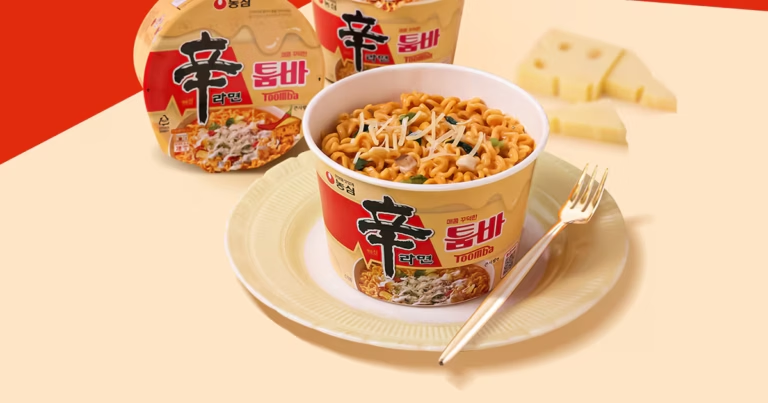
To most Koreans, Toowoomba isn’t a foreign name. You’ll find it on instant noodles, hamburger steaks, and convenience store pastas across the country. Just yesterday at lunch, I ordered a “Toowoomba Hamburg” from a place in Pil-dong. It’s their signature dish. At this point, the name has become shorthand for a specific kind of flavor….

In Dogok-dong, tucked behind a modest sign that simply reads “HAMBURGERS,” sits OneStar, a burger shop where the lighting, menu, and vinyl booths feel lifted from an earlier time. But this isn’t an accident. Everything here is intentional. Carefully curated. Thoughtfully branded. And, crucially, the food lives up to the mood. That, more than anything,…

It’s not every day you stumble across a naturally carbonated spring. In France, there’s Badoit. In Italy, San Pellegrino. These are more than just mineral waters — they’re bottled expressions of terroir, tradition, and time. And in Korea, there’s Chojeong. Tucked away in the countryside of Cheongju, Chojeong is home to a spring that has…

At 7:30 a.m., most restaurants in the neighborhood were still closed. The only one open was a modest, old-school diner with a teal awning and an unmistakable name printed in red and blue: Bogwang Gisa Sikdang. A row of yellow plastic jugs and orange cones lined the front — a simple but effective way to…

Korean Everyday Icons #3 Open any drawer in Korea and you’ll probably find one. You don’t remember when you picked it up. Maybe it signed a lease. Or filled out a delivery form. Or added a name to a list. The pen isn’t special. But it’s always there. Its name is Monami 153. Though most…